Sarah Tibbits
Skull Reliquaries
Head of Mary Magdalene

1200 / 1215; copper (champlevé copper, enameled, engraved and gilded), wood core
Mary Magdalene was one of Christ’s close followers, and was present at his crucifixion and resurrection. Allegedly, the majority of her skull, save the lower jaw, was discovered by Pope Boniface VIII in the Lateran Palace in Rome in the thirteenth century. The jaw appears to have been found later. It was then presented to Charles II of Naples, and a reliquary was designed “with a crown of gold and precious stones”¹. During the French Revolution, such items were commonly stolen and destroyed. A sacristan, or caretaker of a church’s contents, collected it for safekeeping. The current reliquary is from the nineteenth century and is supposed to be a faithful copy of the original reliquary, though it lacks the crown.
Made of gilt bronze and enamel, the head and bust are supported by four angels who appear to gently lift Mary toward Heaven, though none of them have identifying features. Like many depictions of female saints, her hair appears gold. A face-plate can be attached to cover the skull, which appears to be used most commonly during her yearly procession. It’s difficult to tell, from the image, where her gaze rests, but her features are otherwise soft and youthful. What appears to be a clasp on her cloak features the face of Christ. Beneath the bust, a tube of rock crystal contains another of her relics—a small piece of flesh attached above the left eyebrow that detached in 1780¹. Like in the monstrance that once contained her hand, this tube is adorned with gilt leaves and natural elements while allowing the flesh to be seen. The central piece supporting the bust is rendered in an architectural style that sports corinthian columns, thus continuing the natural motif.


Saint Catherine of Siena (not to be confused with Catherine of Alexandria), is particular to this study in that she was not a martyr. She dedicated herself to her faith from a young age, and is famous for her theological works rather than for her death. Eventually, austerity took its toll, and she died from what may have been a fasting-induced stroke. Although originally buried somewhere else, her body had to be moved because the cemetery was too damp².
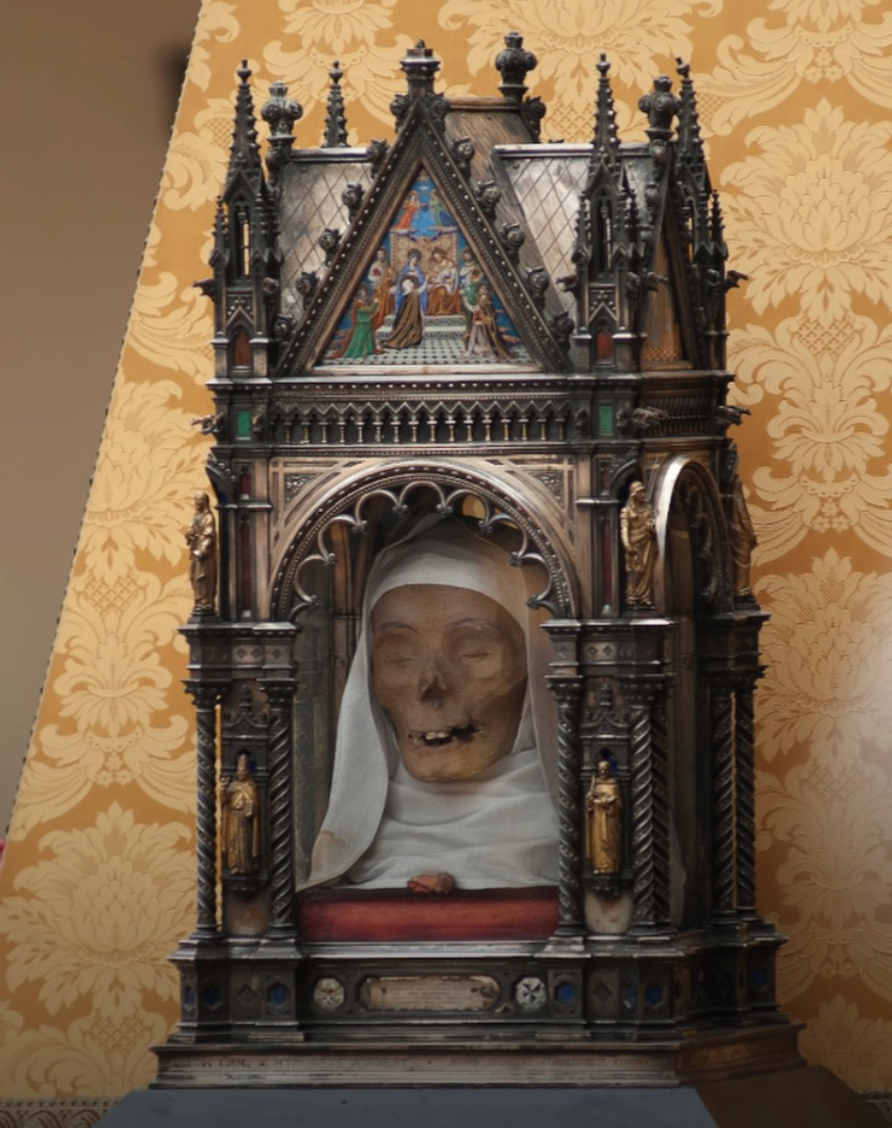
Pope Urban VI gave permission for her head to be removed from her body and taken to Siena, and her chapel was built in 1466 to hold her relics. Her head is considered incorrupt, or incapable of rot due to her holiness.
1200 / 1215; copper (champlevé copper, enameled, engraved and gilded), wood core
This reliquary has been remade several times, and the current one takes the shape of a Gothic church². The enameled scene in the gable likely represents a scene from her life. Images make it difficult to identify the decorative aspects of the reliquary; most of it appears architectural, with fewer natural elements than Mary Magdalene’s reliquaries. Other saints stand in small niches at each corner of the object. She wears a wimple, or headcovering, an article of clothing she would have worn when alive. In affect, she’s portrayed almost as if sleeping rather than dead, with closed eyes evoking the sense that she may wake at any moment. Her slightly parted mouth gives the allusion of breath.
Head of Catherine of Siena
Findings:
Skull reliquaries, particularly ones in which the bones are prominently visible, actually sport less gendered diversity than many other reliquary types. In fact, the skulls act as an equalizer amongst these objects; there is no denying the deathly association that stems from viewing a person’s skull. Neither can the type of skull be denied. In some reliquaries, like the monstrance holding Mary Magdalene’s tooth, it’s debatable whether the bone came from a human at all. With a skull, any uncertainty is wiped away. Yet there are still ways to obfuscate the connection between relic and death, if only slightly.

The skull of Saint John the Baptist (right/left) has been kept in Amiens since 1206³, though its current reliquary was made in the 19th century. This reliquary is more simple than the other two, but as usual, this is likely a sign of the times in which it was created. There appears to be some sort of filler set into the eyes and nasal cavity, detracting from the hollowness of those typically empty sockets. Interestingly, closed eyes have been carved into the eye fillings to make him look like he’s sleeping rather than dead. This is similar to Catherine, whose somewhat mummified head gives off a similar sensation. Her eyes too appear closed. In this way, both relics attempt to bring life back into their subjects. A lack of iconic depictions removes many of the common depictions of violence from the equation, and with their ‘closed’ eyes, viewers might assume they died peacefully in their sleep (hint: they did not).
Head of St. John the Baptist:
19th century; silver, gilded silver, gems, rock crystal, enamel³
Mary Magdalene’s skull, on the other hand, does not itself shy away from a deathly visage. No alterations have been made to the skull to make it appear more lifelike, but she does have a golden faceplate that can be used to cover the skull entirely, positioning her as a young, radiant woman. Hints of violence do not come into play on her reliquary either. Although the method of shifting these skulls away from death, even if only slightly, is different, the overall desire is to imbue the saints with peace and life regardless of gender.
References:
-
“The Holy Relics,” Basilique Sainte Marie-Madeleine, accessed May 10, 2026, https://paroissesaintmaximin.fr/basilique/les-saintes-reliques/.
-
“Basilica Of San Domenico,” Santa Caterina, accessed May 10, 2026, https://santacaterina.siena.it/the-basilica-of-san-domenico/?lang=en.
-
“The relic of the head of Saint John the Baptist,” Towers and Treasury of Amiens Cathedral, accessed May 10, 2026, https://www.cathedrale-amiens.fr/decouvrir/la-relique-du-chef-de-saint-jean-baptiste.