Sarah Tibbits
Architectural Reliquaries
Reliquary Shrine
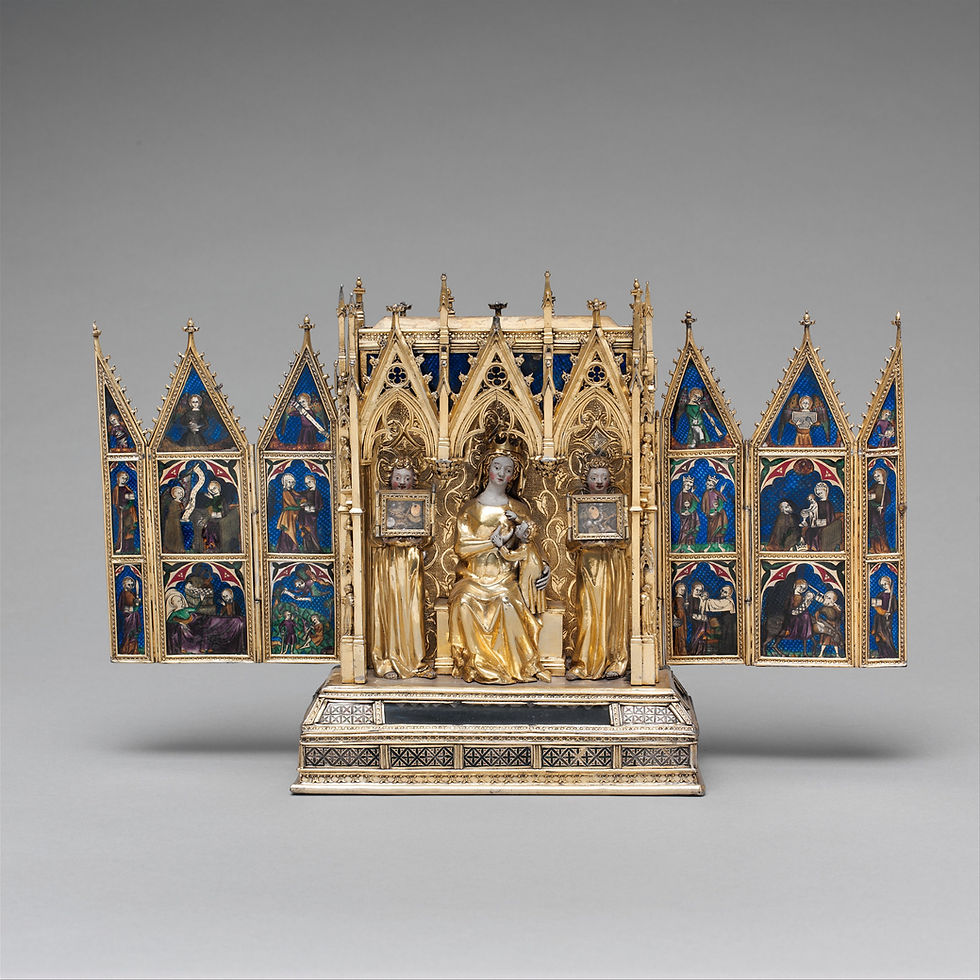
ca. 1325–50; Gilded silver, translucent enamel, paint
Attributed to a French craftsman, Jean de Touyl, this work was originally kept in the convent of the Poor Clares of the Order of Saint Francis in Budapest¹. As the convent was founded by Queen Elizabeth of Hungary, it may have been commissioned by her on behalf of the convent. It is one of only four of its kind.
The shrine is an elaborate imitation of a cathedral, featuring arches, vaults, and a set of hinged doors. Enamel panels depict scenes from the lives of Mary and Christ¹, as well as showcasing several saints and angels. Saint Catherine of Alexandria is depicted with her wheel and sword, smiling softly. The figure on the panel to her right (when closed) may be Catherine of Siena. Below, a frowning man carries a cross and book, two symbols commonly attributed to Saint Andrew. Inside the doors, Mary sits nursing a baby Jesus. Her painted lips and cheeks seem to be a convention that continues to appear on statues of holy women throughout the centuries.

Reliquary Shrine of Saint Barbara
The reliquary does not depict any one single church, but rather combines architectural styles of different periods². It is made primarily from silver or silver-gilt. Unfortunately, the images provided by the MET do not make clear the figure inside the central tower, nor do they list who it might be, though it is likely a depiction of Saint Barbara. This may be representative of her story, in which her father locked her in a tower. The three windows on each side support this idea; Barbara’s tower originally had two windows, but she requested for a third to represent the trinity and show her dedication to her faith.


Attributed to the workshop of Luigi Parmeggiani from 1880-1900, it appears to be a modern fabrication based on Gothic styles². The relic inside is inaccessible, which is uncommon.
ca. 1880–1900 (14th–15th century style); Silver, Silver-gilt
Findings:
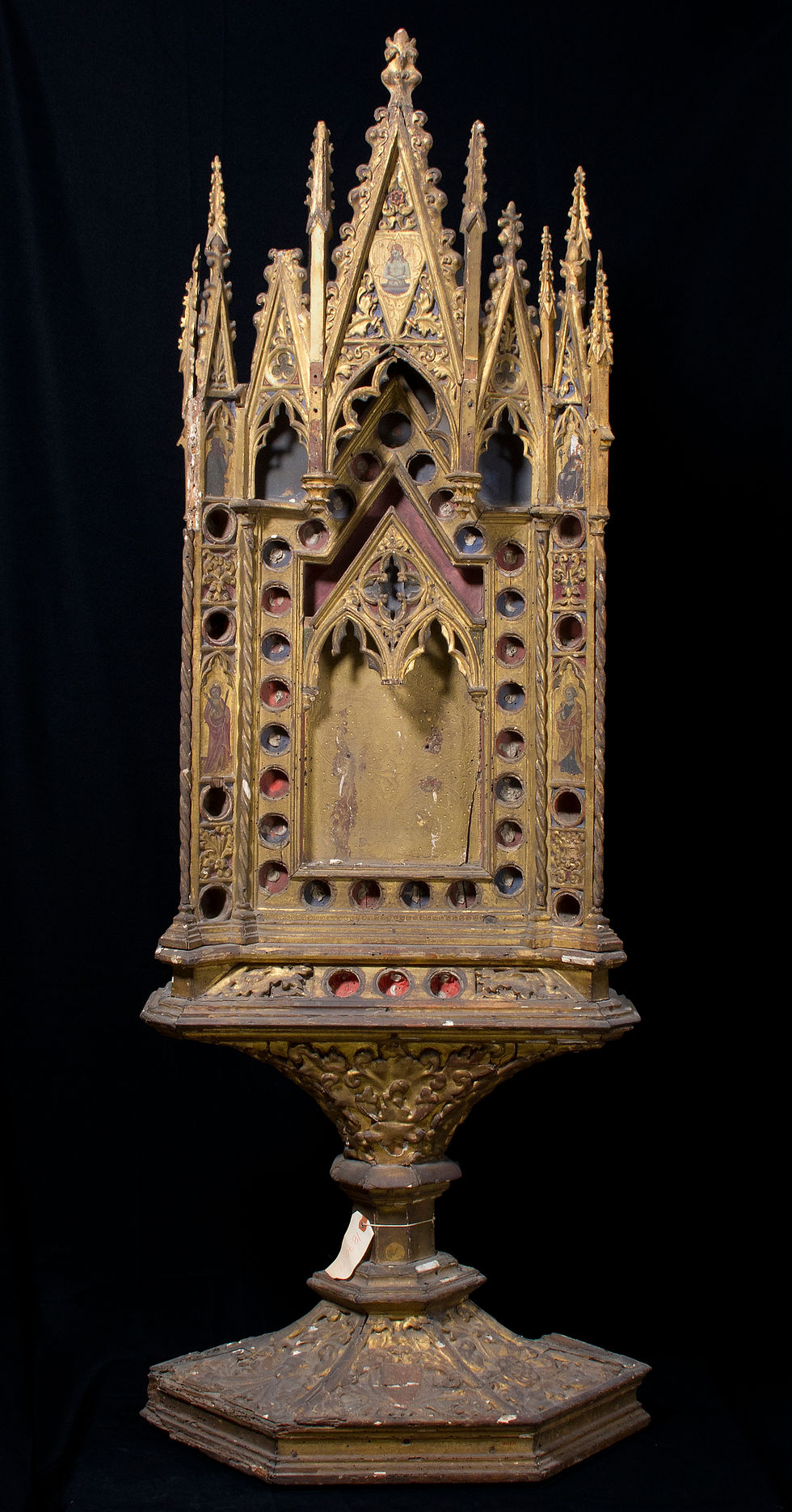
Reliquary
The most obvious gendered difference manifests in terms of violence. Although the Shrine of Saint Barbara features almost no iconic depictions, other than a statue barely visible in pictures, it also features no violence. Barbara’s death is never even hinted at, despite the fact that the viewer, believing the object to hold her relics, logically knows she was martyred. The Reliquary Shrine features several images of saints; all the women smile gently while the men wear massive frowns. This gender marker is of interest—as each saint tends to carry the object of their execution, it suggests that every woman walked gladly into her death while the men resented the dying. It allows men to have and show negative emotions surrounding their suffering. This is particularly jarring when considering saints like Catherine of Alexandria, who was threatened with a spiked breaking wheel before being beheaded. I personally would not consider that an optimal scenario. Meanwhile, this reliquary exhibits the bloody aftermath of the crucifixion. In fact, with his eyes closed, Christ appears dead. Thus, even the ultimate symbol of everlasting life can be shown in the torment of death, while none of the female saints are allowed to acknowledge their misery.
When it comes to comparing architectural reliquaries, the gendered difference appears to be overall less prevalent than what we might see exemplified in busts. These containers concern themselves much more with shape and emulating the form of a church than with iconic depictions of saints, though small figurines tend to make an appearance. Painted icons are less common; the Reliquary Shrine above is a notable outlier when it comes to detail, what Farge might refer to as "singular"³.
This shrine (left) is an Italian piece contemporaneous with the Reliquary Shrine, though considerably less detailed. Almost no information about it exists, and many parts have broken off. Unsurprisingly, it takes the form of a gothic church. In the front, under the two small arches in the center, there were likely two statues or rock crystal containers for relics. The small circles throughout the structure would have, at one point, contained several relics for viewing. The most notable painted section is an inverted triangle near the top featuring Jesus after the crucifixion, bleeding from his hands and the side-wound he was given when stabbed with a spear.

14th century; Wood, paint and gilding
References:
-
“Reliquary Shrine,” The MET Museum, accessed May 10, 2026, https://www.metmuseum.org/art/collection/search/470310.
-
“Reliquary Shrine of Saint Barbara,” The MET Museum, accessed May 10, 2026, https://www.metmuseum.org/art/collection/search/468466.
-
Farge, Arlette, The Allure of the Archives (Yale University Press, 2013), 92, ProQuest Ebook Central.